
DUCATI 125 GRAND PRIX – A FABULOUS DESIGN BY THE GENIUS FABIO TAGLIONI
Text and Colour Photographs : José Manuel Serrano Esparza
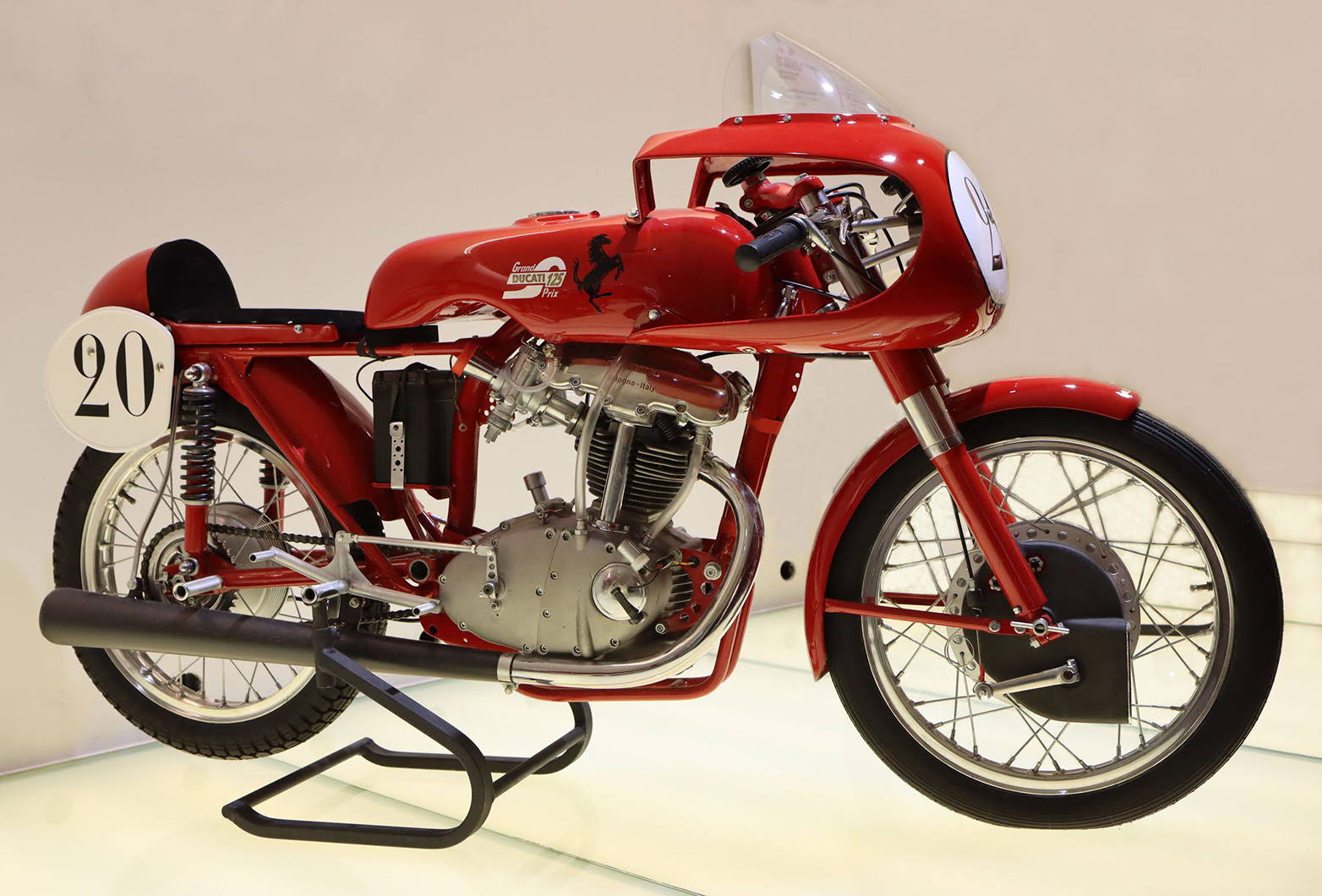
Ducati 125 Grand Prix Bialbero from 1956, driven by bevel gears inside the Ducati Museum at Borgo Panigale, Bologna (Italy). A riveting sight defining the dawn of the mythical Transalpine motorcycling firm and one of the most beautiful bikes ever made.
It is an air-cooled single-cylinder dreaming machine, featuring a four-speed gearbox, double overhead camshaft, bore x stroke of 55,3 x 52, 16 hp power at 11,500 rpm and a top speed of 175 km/h.
After his arrival at the Italian motorcycling company Ducati in 1954, the genius of mechanics Fabio Taglioni had consolidated the Borgo Panigale firm as a manufacturer of world-class bikes, with the creation in 1955 of the 100 cc and 125 cc Ducati Gran Sport Marianna motorcycles, first single-cylinder bevel gear ones handcraftedly made at Borgo Panigale (Bologna).
Both of them were pioneers in the Ducati history of competition, winning a number of races, particularly in the scope of endurance, including two editions of the Milan-Taranto and three editions of the Motogiro, in addition to proving that it was feasible to build motorcycles with capacities of up to 350 cc at industrial scale.
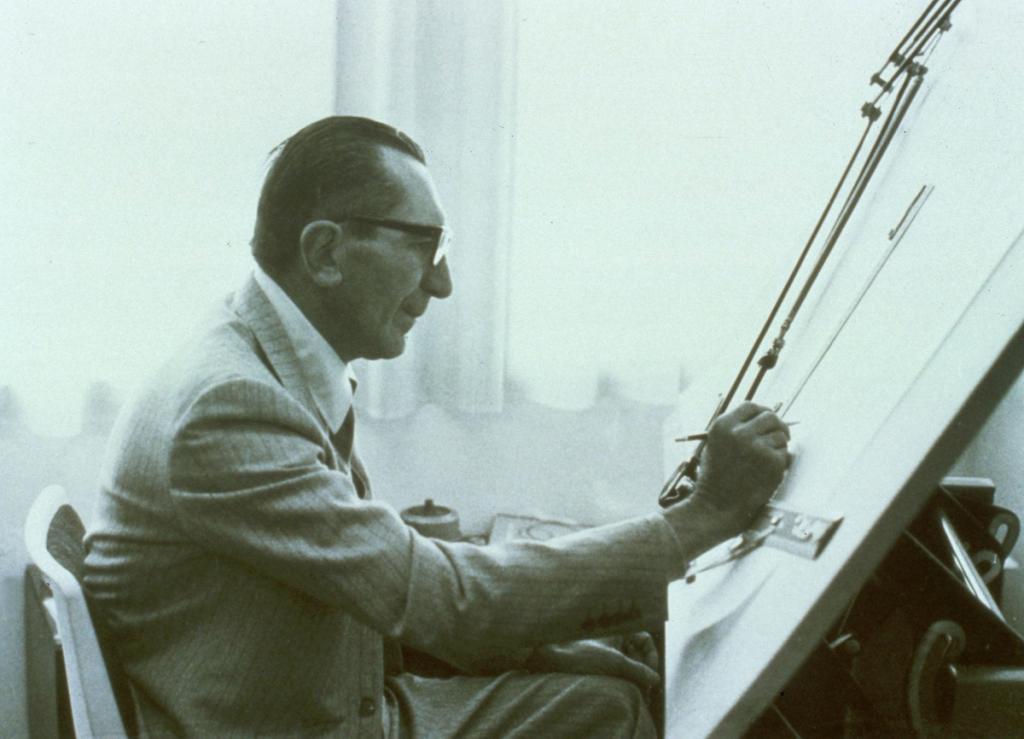
Fabio Taglioni, Chief Designer and Technical Director of Ducati between 1954 and 1989. A full-fledged driving force in himself, this hugely talented engineer, highly influential in the motorcycling history, spawned constant brainstorms throughout his professional trajectory, giving birth to a lot of iconic bikes and revolutionary single-cylinder and two-cylinder powerplants, such as his V-Twin 90º desmodromic engine, invented by him in 1971, still used in vast majority of Ducati bikes.
And the rigid but exceedingly light Trellis multitubular chassis made of chrome/molibdene stainless-steel was likewise incepted by him, becoming a fixed component of his motorcycles since mid seventies onwards.
A visionary man boasting tremendous knowledge, experience and innovating spirit, he was author of more than one thousand projects for the Borgo Panigale firm, always having enough stamina aqnd motivation to overcome a myriad a raft of major technological challenges during his 35 year tenure as Ducati Technical Director between mid fifties and late eighties.
But Taglioni also possessed a fairly brilliant asthetic sense, which together with his impressive mechanic gift brought about an extraordinary technological and entrepreneurial advance in Ducati.
Nevertheless, Fabio Taglioni didn´t rest on his laurels. He was imbued by the philosophy that winning races was the best way to assure for Ducati a privileged place within the international motorcycling industry.
It is a bike standing out both because of its highly avant-garde concepts of Italian design for its time and its incredible beauty of shapes.
And in 1956 he decided to design and manufacture a new single-cylinder 125 cc bike sporting double overhead camshaft (improving the performance over the previous single-overhead-camshaft Ducati Gran Sport Marianna 125 cc from 1955), vertical axle and bevel gear driven engine, created with the aim of winning the 125 cc World Championship.
But simultaneously, a further significant goal for the eminent Italian designer was to beget a more modern chassis, with far superior aerodynamics and spectacular beauty and elegance of contours, which would be the base for future racing Ducati bikes, in which besides, he would introduce a groundbreaking device : the desmodromic distribution system lacking springs, avoiding the risk of floating valves and the heavy springs for energy drawing used to close those valves, attaining much more efficiency at the highest rpm it could reach, along with an overall much better performance, on opening and closing the valves with a camshaft rather than relying on springs for the closing area.
Therefore, the single-cylinder air-cooled Ducati 125 Grand Prix with twin cam engine of the valve spring type and 5-speed gearbox was born in 1956, oozing Italian elegance and style to spare, an unutterable exquisiteness of lines all over its surface and fork valve springs, five-speed gearbox reaching 16 hp at 11,500 rpm, with a weight of 90 kg and a maximum speed of 175 km/h, also being called ´ bialbero ´ because of the two camshafts featured by its powerplant.
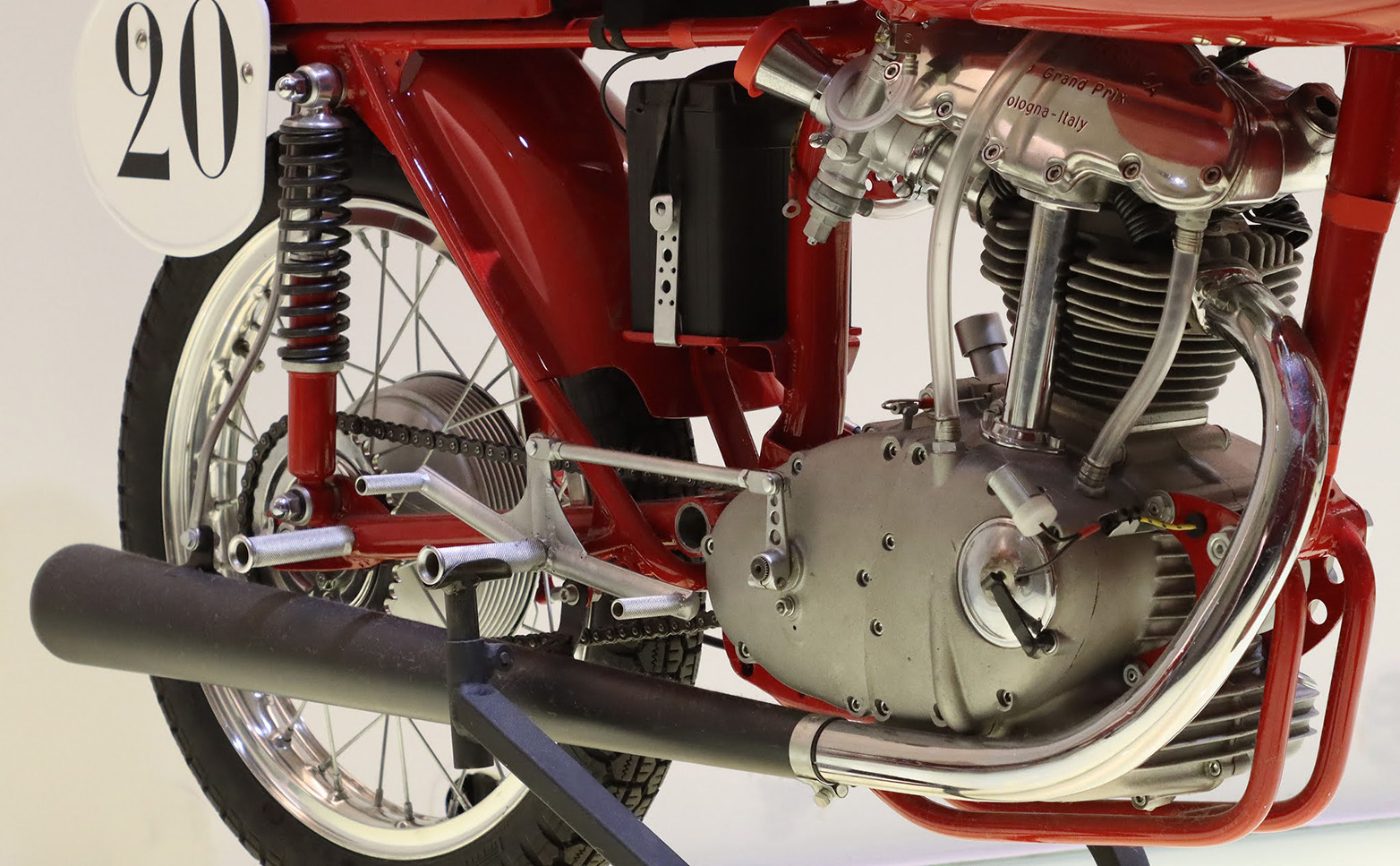
The zone over it bearing the letters 125 Grand Prix Bologna-Italia is the distribution cover making the valves go up and down, and on its left is the Dell´Orto SSI 27A carburettor, beside which is the original battery.
Both the engine block and the cylinder are made with very high quality aluminium alloy, exhibiting a superb appearance clearly revealing the mastery Ducati had already achieved in the treatment of metals during this initial stage of its history.
The design of this motorcycle was a milestone brimming with charm and sculptural qualities, together with a first-class metallurgy and a handcrafted work made without any compromise whatsoever.
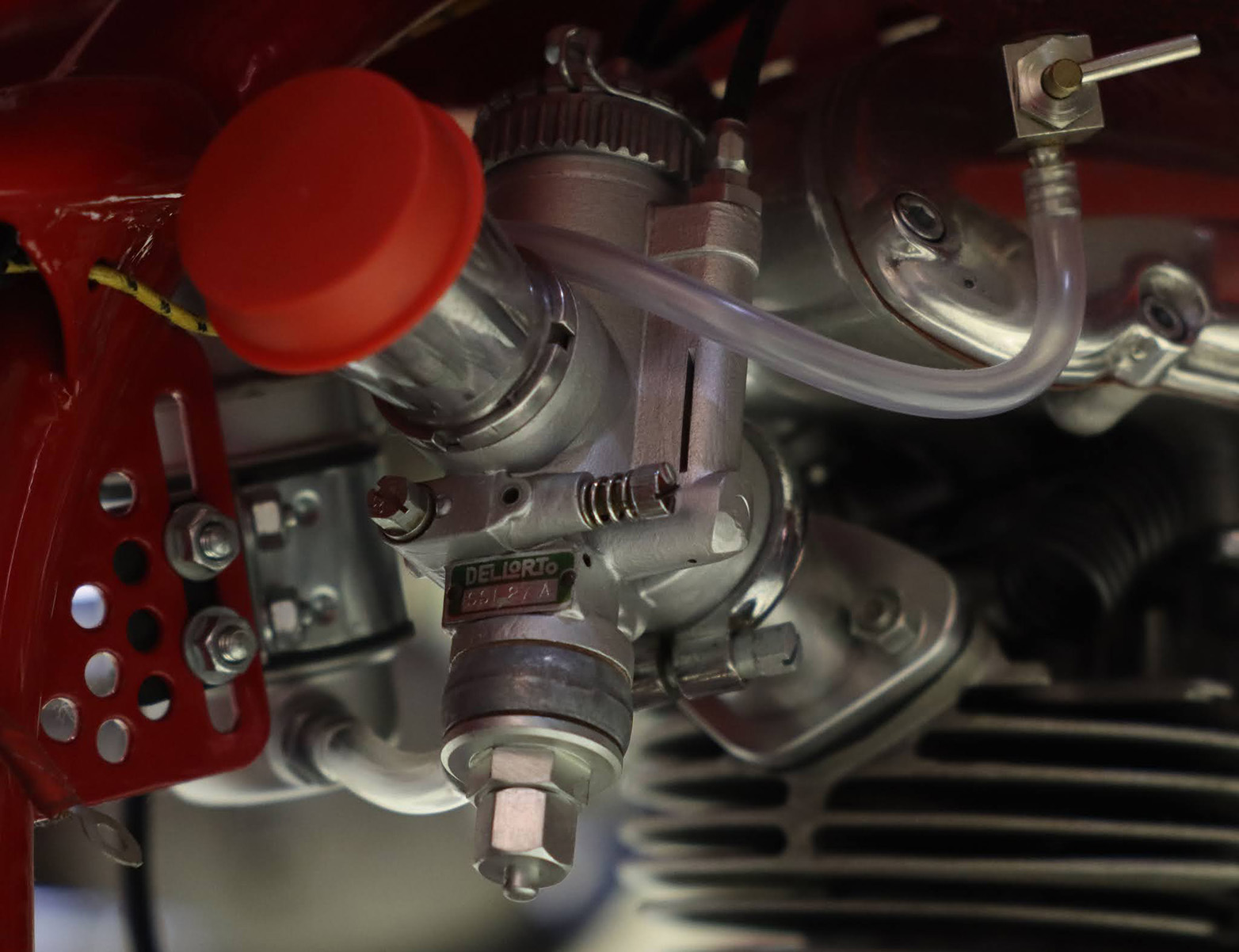
Detail of the Dell´Orto SSI 27A carb fed with gas through the tube placed in the upper central and right areas of the image, once the fuel tap (visible in the top right zone) is opened.
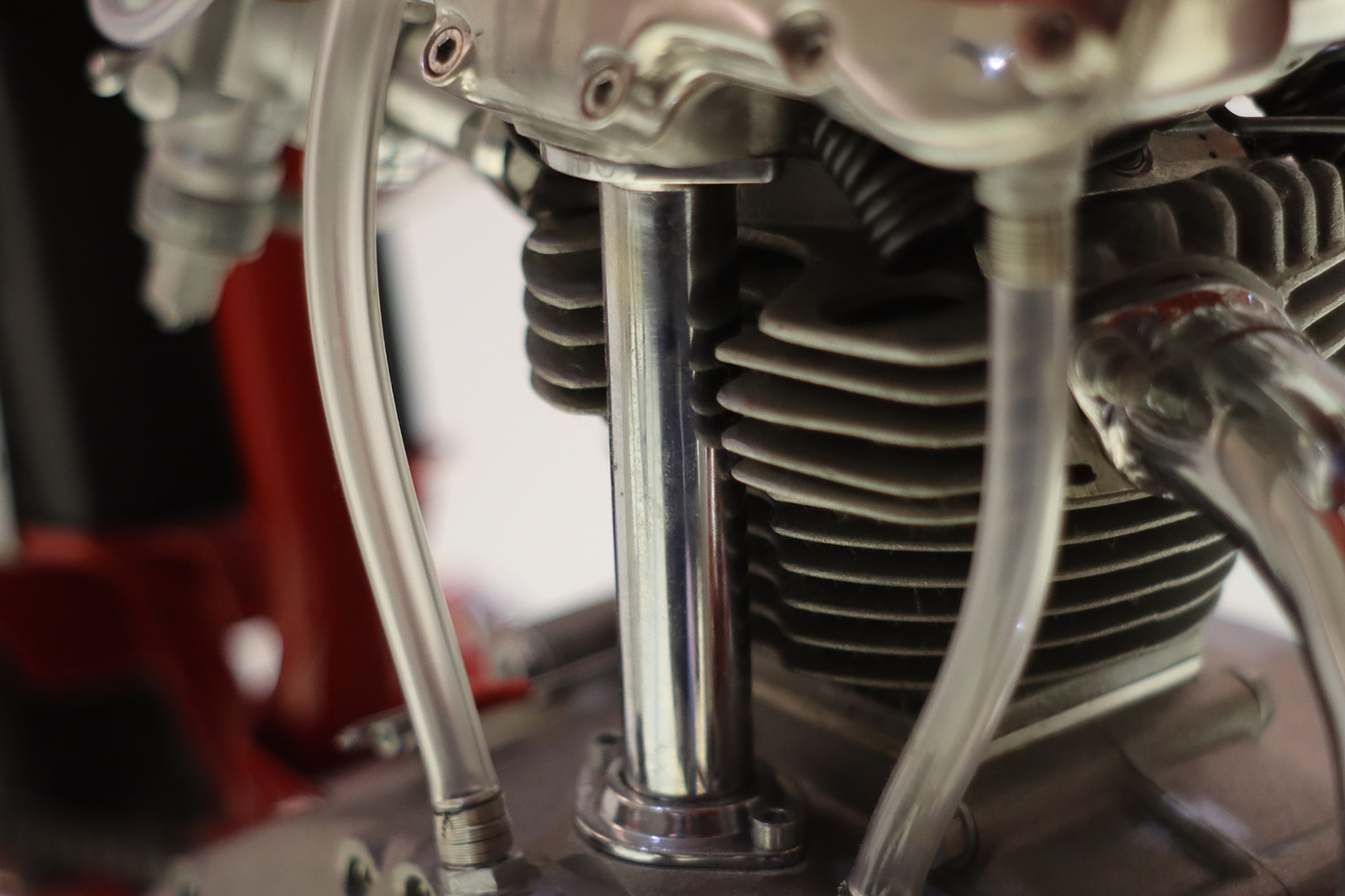
Detail of the Ducati 125 Grand Prix cylinder. In front of it can be seen the large metallic tube inside which is the main shaft with double overhead camshaft and two bevel pinions turning the vertical movement into horizontal one.
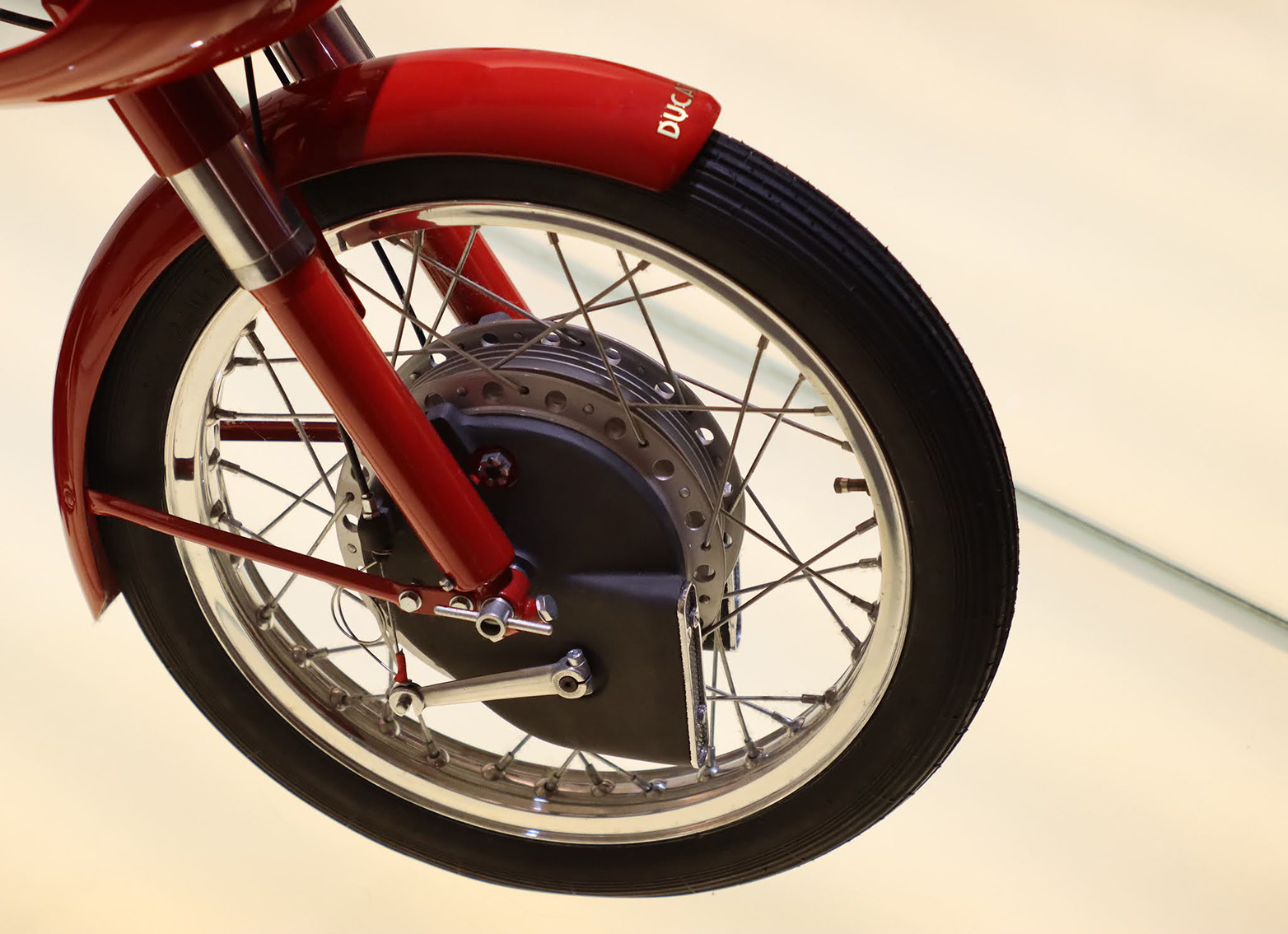
Front wheel of the Ducati 125 Grand Prix, showing the telescopic forks, the black colour cover of the drum brake and the very magnesium Amadori front and rear drum brake (incorporating a cam) just beyond it. This kind of brake has a very large surface of contact, so the chromed opening in both brake covers lets the air enter to cool the whole braking system.
This is a very genuine and gorgeous single-cylinder classic bike harking back to a glorious period in the History of Motorcycling.
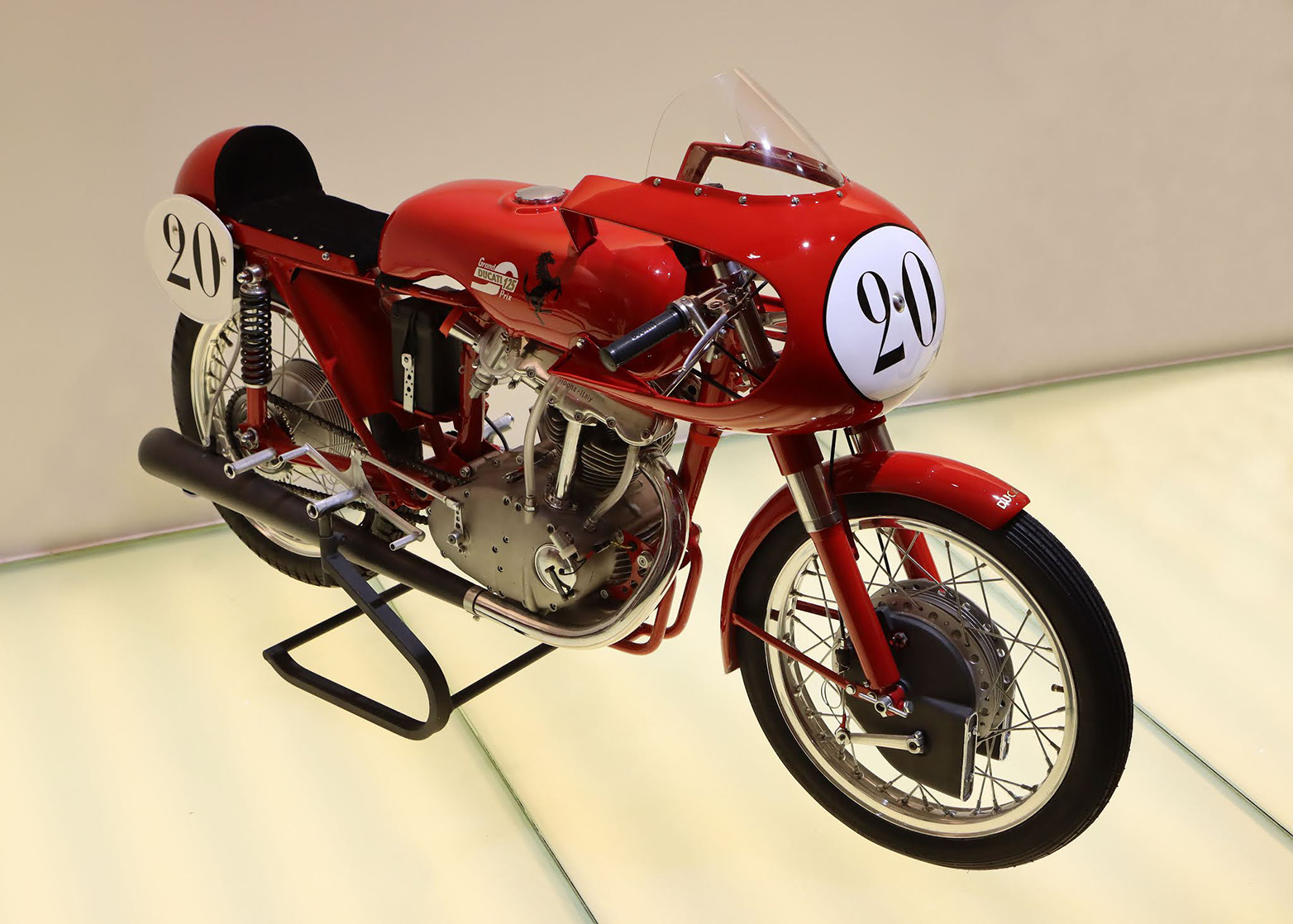
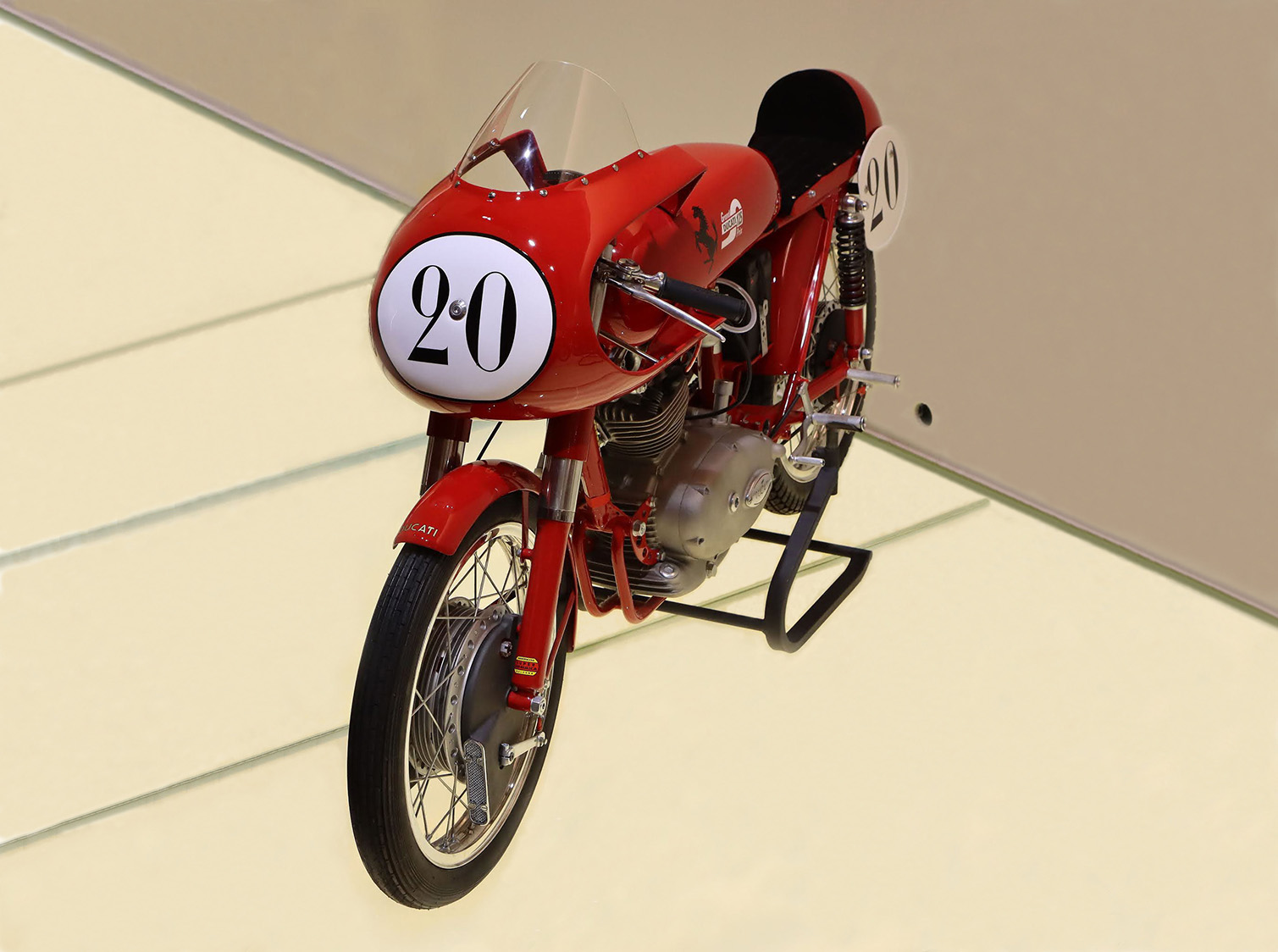
Another image of the Ducati 125 Grand Prix, a motorcycle wrapped in the most typical Italian elegance, style and strong character, exuding a timeless slender and alluring gorgeousness in its design, summing up the gist of Borgo Panigale bikes regarding contours, painstaking attention to detail, working ethics of manually made manufacture and an unflinching search for beauty in its shapes. A bike belonging to a golden era in which designers relished a great technological and artistic freedom when it came to creating their two-wheeled machines, trying every possible approach.
Though Ducati didn´t nail the 125 cc World Championship with it (being beaten in top speed by the MV Agustas), the Ducati 125 Grand Prix was a landmark bike, since it paved the way for the contours of the Ducati 125 cc GP Trialbero Desmo, also introduced in 1956, with a power of 19 hp at 12,500 rpm and first desmodromic Borgo Panigale bike, whose birth was a turning point in the history of engineering applied to motorcycling, raising the bar with a constructive mentality based on utterly mechanic and highly efficient small engines hugely improving performance, reliability and operating security, making that the valve followed the timing diagram with the greatest possible precision, leveraging a desmodromic design boasting triple camshaft with barely energy loss and an excellent uniformity of performance inside corners, which meant a new baseline in comparison to all the previous Ducati bikes using conventional springs to open and close valves.
Obviously, the reliability of the Ducati 125 Grand Prix was not optimum at high revs, since valve-to-piston clearance was critical with the higher compression ratios that would be soon needed from mid fifties onwards, and the added problem of valve float and the wide included valve angle of 80 degrees.
But this iconic bike is a truly exotic and wonderful example of Italian racing machine from fifties, and at its moment, it was the most advanced small-capacity racing motorcycle Ducati had produced, to such an extent that it laid the technical foundation for the company´s long and successful competition history, with a technology that was extraordinary for a 125 cc motorcycle of the period.
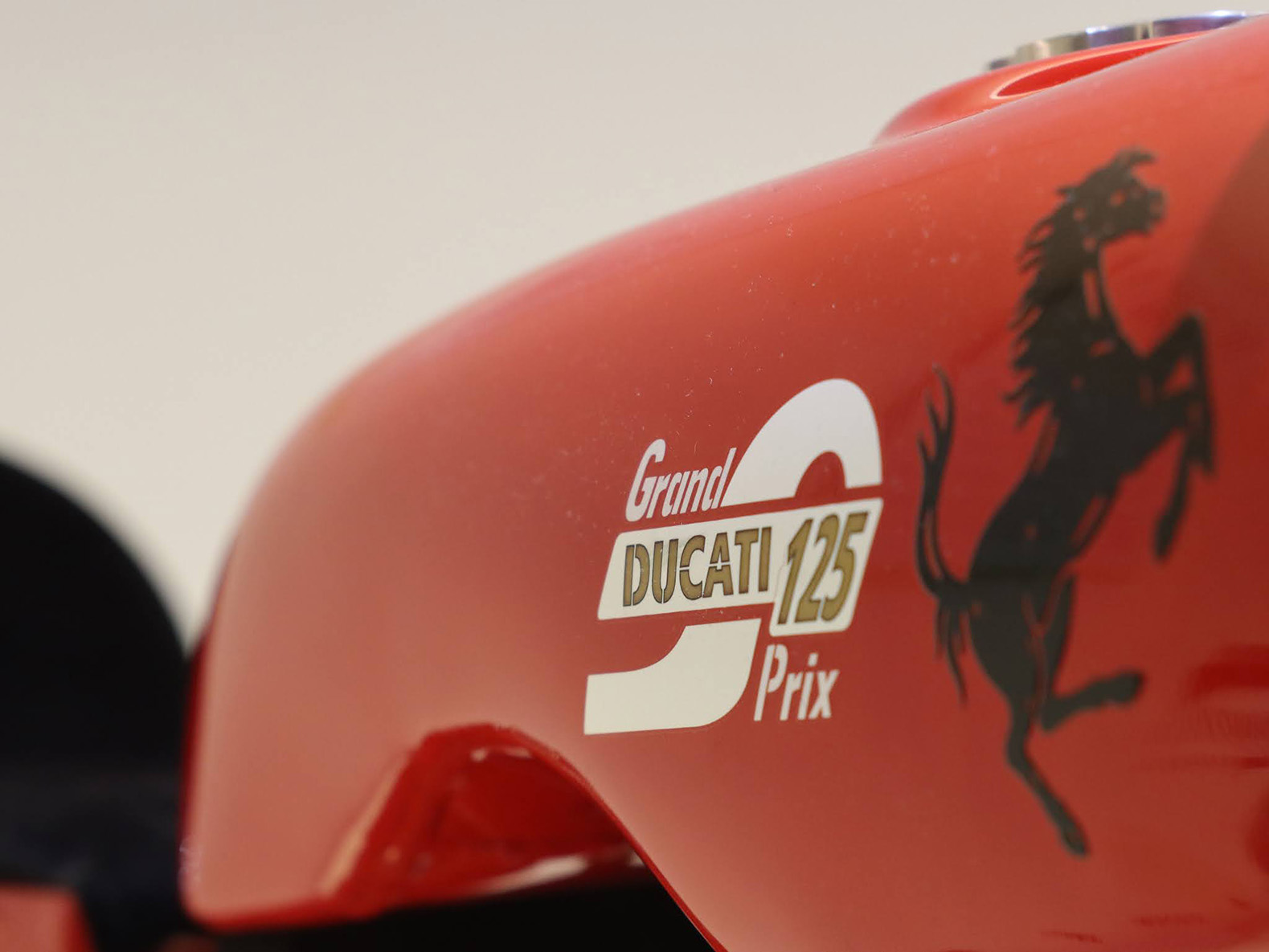
Suffice it to say that its structural housing containing the components of the engine, providing support and protection to the internal mechanisms, was made by Ferrari´s racing division.
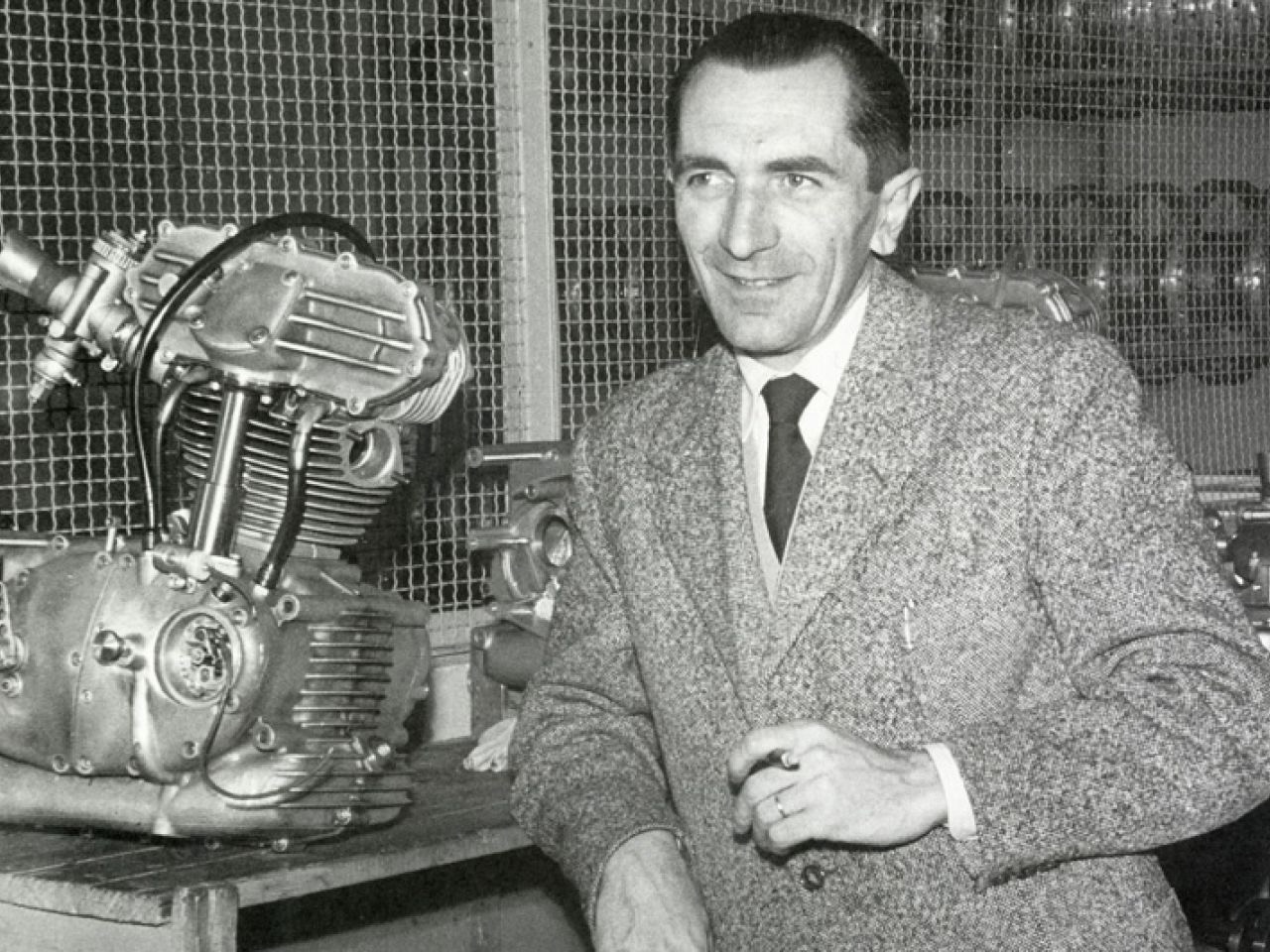
Whatever it may be, Fabio Taglioni would soon go beyond himself developing the desmodromic system of distribution for Ducati racing bikes, departing from the original concept pioneered by the highly successful and mythical Formula 1 Mercedes W196 Grand Prix and 300 SLR sports cars during 1954 and 1955, but adapting its fundamental keynotes with a myriad of technical solutions of his own to new very small and amazingly efficient desmodromic engines for Borgo Panigale racing bikes, having already been able to get a 20 percent increase in engine revolutions with his first desmodromic Ducati bike prototype in 1955 (one year before the Ducati Desmo 125 GP from 1956), by eliminating valve float, which happened when a valve spring couldn´t close the valve quickly enough to complete the ignition cycle.
Anyway, the Ducati 125 Grand Prix Bialbero, of which only 50 units were manufactured between 1956 and 1959, stands as a cornerstone in Ducati´s racing legacy.