
DUCATI DESMOQUATTRO MODELS: 851 TO 916
Words: Harné Heuvelman Photographs: Phil Aynsley
At Back to Classics, we are most concerned with the bevel-driven Ducati models with an occasional early belt-drive coming in our workshop. But we have not to overlook the ‘future’ of classic Ducatis. On the horizon we see a new category emerging: the Desmoquattro models of 1988 to 1998.
So let’s take our first steps in the realm of four-valves per cylinder, water cooling and electronic fuel injection by diving into the history of the Desmoquattro models. It would come to no surprise to Ducati enthusiasts that this story also begins on the race track.
1986 – The Quest for Power
By the second half of the 1980’s, Ducati’s 750 F1 proved to be the ultimate of the Pantah engines and was designed at the limit of the technical possibilities of a two-valve per cylinder and air-cooled engine. Although it was a great bike with exceptional handling, the power output was at a fairly low level, especially compared to the Japanese competition. As a true racing company, Ducati started thinking about a more modern engine design that could be at the forefront of the modern Superbike racing class.
With chief engineer Fabio Taglinioni in semi-retirement, the project was handed to his soon-to-be successor: Massimo Bordi. Although Taglioni was very skeptical towards four-valve technology, Bordi was far more enthusiastic about this. He gave Gianluigi Mengoli the assignment to draw a four-valve desmo cylinder head but made sure he did this from his home to avoid the fury of Taglioni.
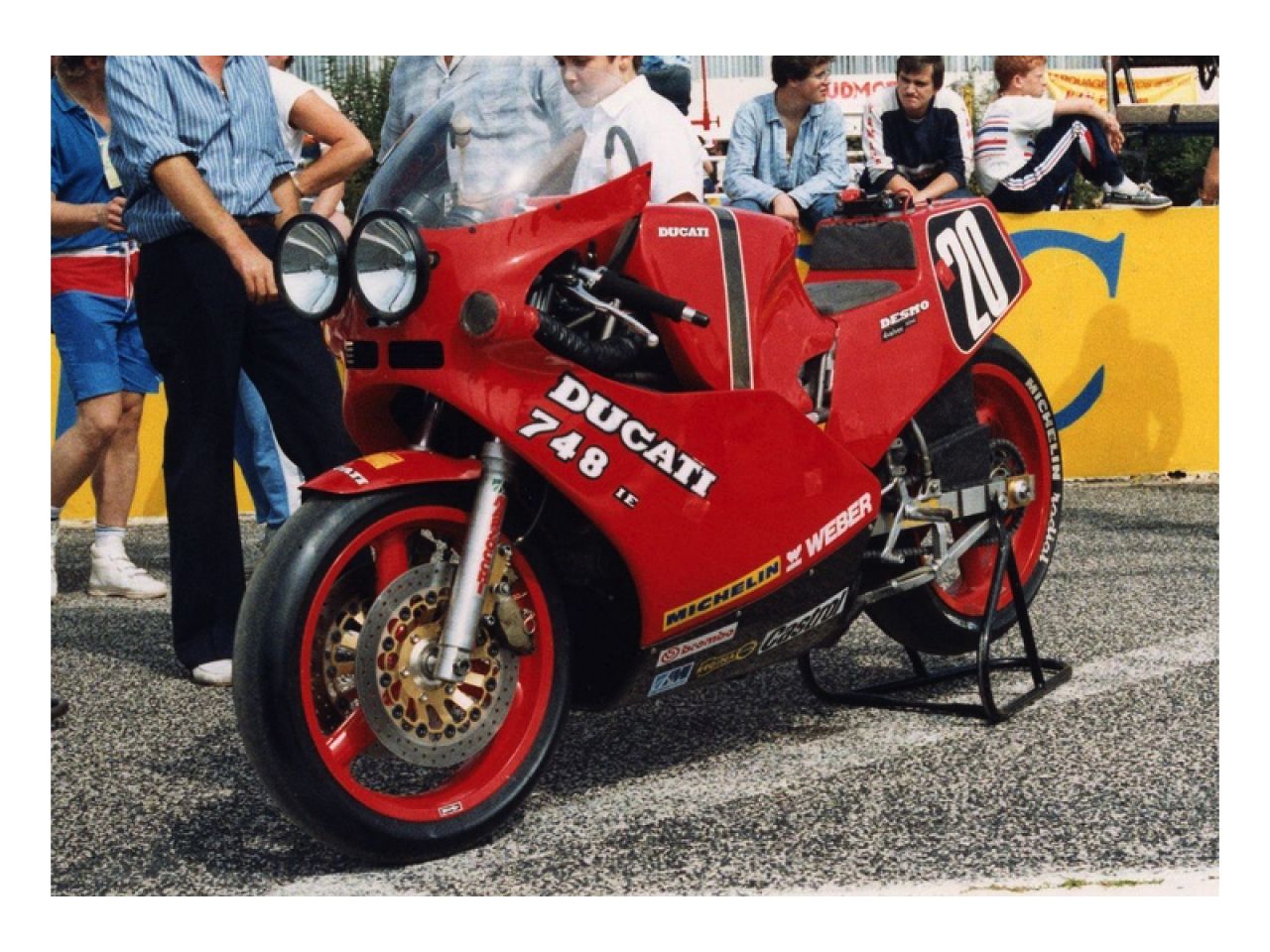
It resulted in a double overhead camshaft, four-valve per cylinder, desmodromic head with direct fuel injection. These were fitted to modified Pantah crankcases and 88×61,5mm cylinders creating a 92 horsepower 748cc engine. With the engine fitted to a heavily modified TT1 frame, the 748 I.E. racing bike was born.
The 748 I.E. was entered to the Bol d’Or 24 Hours race at Paul Ricard, France in September 1986, driven by Marco Lucchinelli, Juan Garriga and Virginio Ferrari. After 13 hours of racing the team had to retire with a broken con-rod bolt.
A lot of knowledge was gathered with the 748 I.E. and the bike evolved to the 851 of 1987. With redesigned cylinder heads, a strengthened crankcases and power output now reached 120 bhp at 10,500 rpm. With a frame mostly similar to that of the earlier 748 I.E., Lucchinelli rode the 851 to victory at Daytona’s Battle of the Twins in 1987.
The experiment had proved to be successful and Ducati decided to enter the World Superbike Championship with the 851 in 1988. At its dream-debut on April 3, at Donington Park, Lucchinelli won the race! Much of improvements were made during this first Superbike season and the title was in sight. However, due to financial problems, Ducati could not enter the last two races of the season and Lucchinelli finished 5th overall.
1988 – A Desmoquattro for the Road
Ducati had to homologate the 851 for the Superbike championship in 1988 and so the 851 Superbike Kit was introduced to the public. The engine was a tuned down version of the racer, using Pantah crankcases as a basis.
In true Ducati style this too was a limited edition uncompromised ‘racer for the road’, as the 750 Super Sport, 900 Mike Hailwood Replica and the 750 F1 were before. Many components came directly from the racing department, like the Marvich 17 inch magnesium wheels and fully floating Brembo P4 brakes.
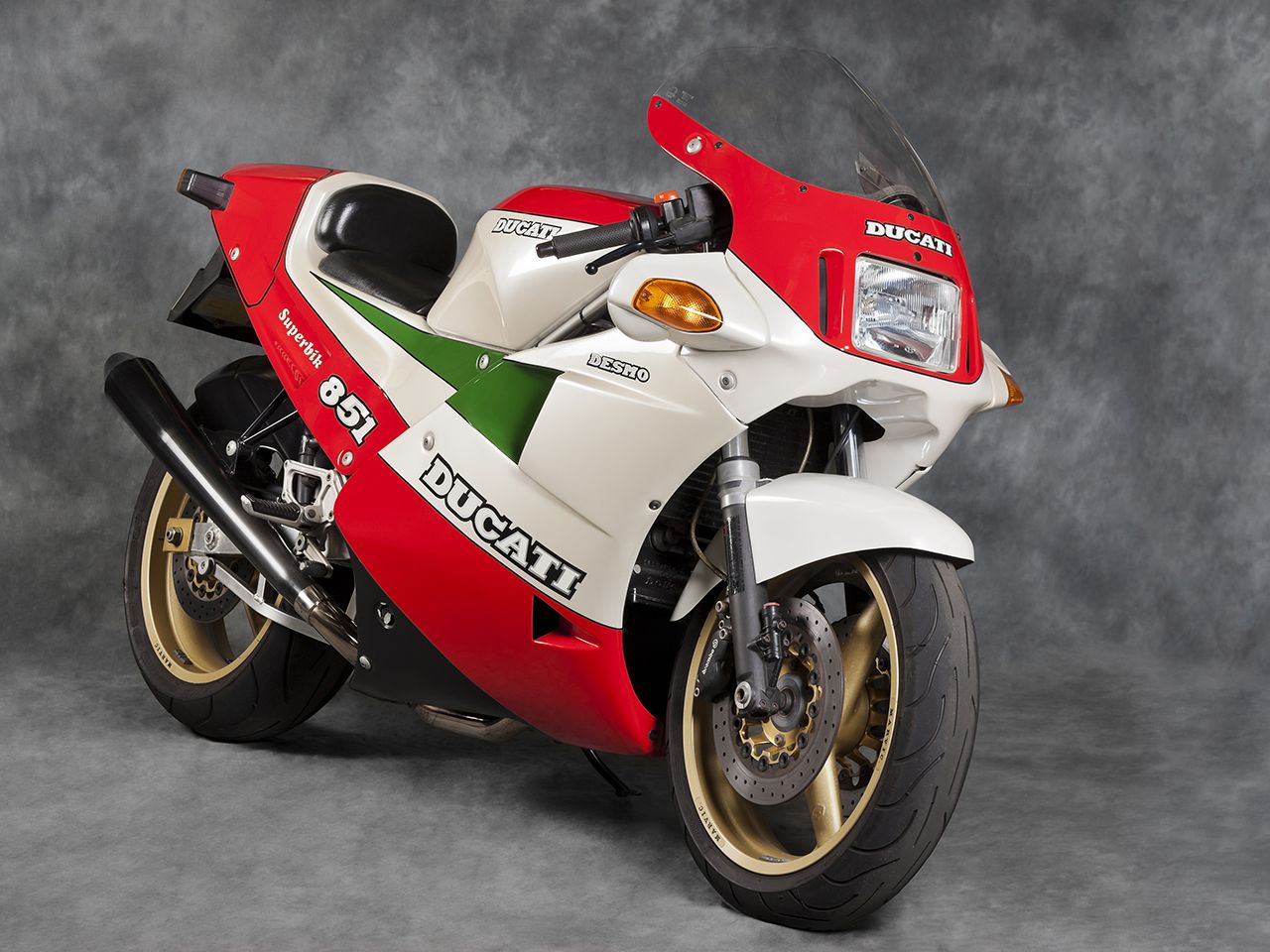
A second model was introduces simultaneously: the 851 Strada. Although many specification were shared with the 851 Superbike Kit, the Strada had 16 inch Marvic/Akront composite wheels fitted but without any changes to the geometry of the frame. The result was a rather poor handling bike, especially compared to the Superbike Kit. Only around 300 Strada’s were produced in 1988.
With Ducati Corse now at full ‘attack mode’ in the World Superbike Championship (SBK) in 1989, the 851 Strada received a major update with 17 inch Brembo wheels, although losing its superb Brembo floating discs. In 1990 the Strada received a dual seat, a Showa front fork and Öhlins rear suspension.
The homologation rules of the SBK dictated Ducati to sell the 851 Sport Production 2 or 851 SP2 in 1990. Although titled 851 the engine actually displaced 888cc. The SP2 received high quality Öhlins suspension, fully floating Brembo disc brakes, 45mm Termignoni exhausts, an aluminium rear sub frame and a monoposto seat. Again, a true racer for the road, the 851 SP2 may have been uncompromised, it also set the standards in 1990 when it came to handling an performance.
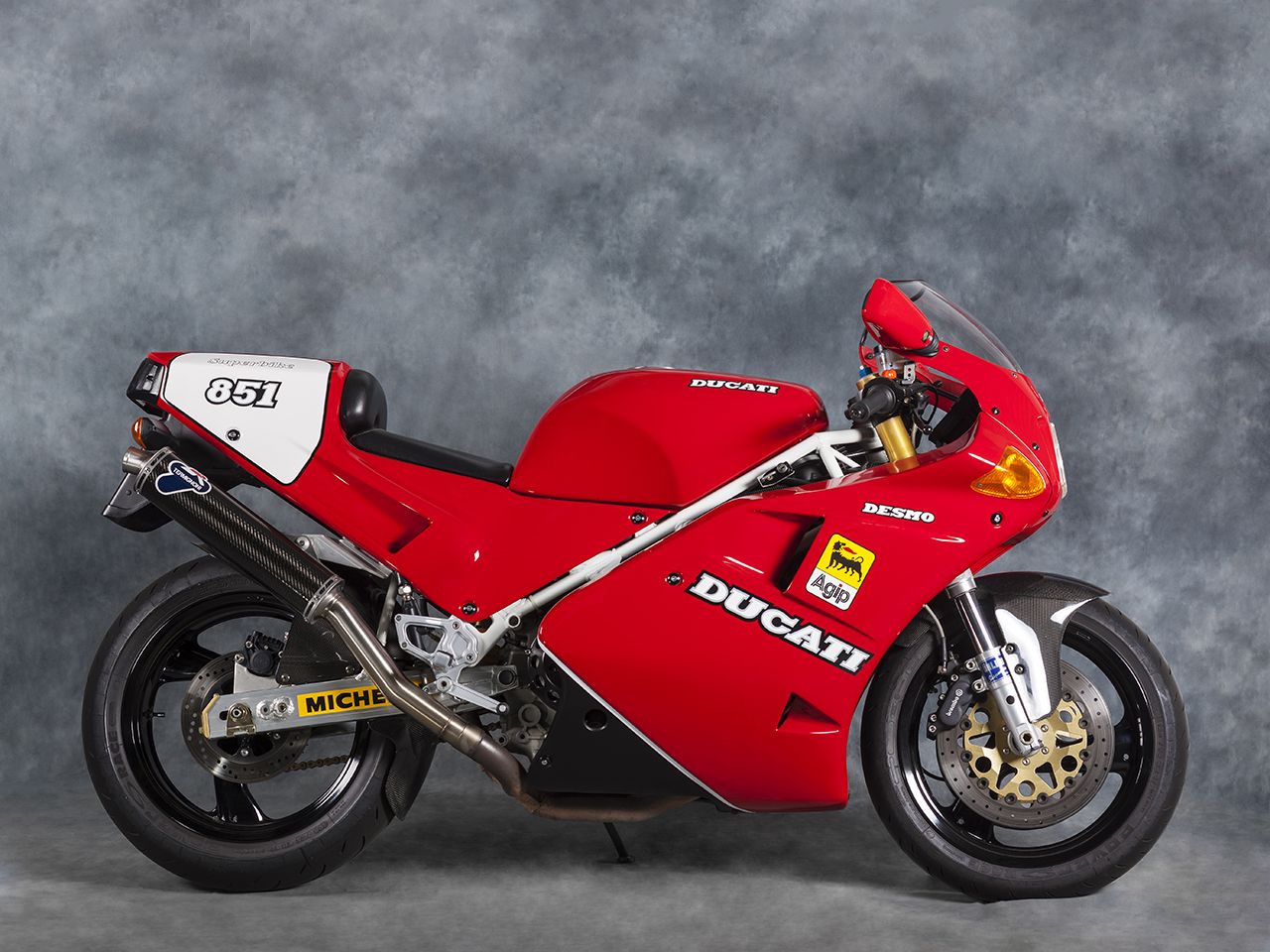
Meanwhile, with eight victories in the 1990 season, Raymond Roche won the first World Superbike Championship title for Ducati. It soon turned out that Ducati would also turn out to be the team to beat in 1991 as Doug Polen won the championship on the Ducati 888.
1991 saw the introduction of the 851 SP3, with only minor changes to the 1990 SP2: the Termignoni exhausts were mounted higher and the Brembo wheels were now black. The engine received higher compression pistons and air intake was now forced.
While both the official SBK racers and the Sport Production models already had 888cc, the 851 Strada was still available in 1992. With a minor facelift, the 1992 851 Strada had a new dual seat design (with passenger handles), newly designed foot pegs, a curved radiator and a pivoting steel fuel tank. Suspension was now Showa front and rear and the Strada got a ‘Gold Series’ Brembo brake system.
In the Sport Production ‘department’ two models were available in 1992: the 851 SP4 and the 888 Sport Production Special (SPS). The 851 SP4 was quite similar to the 851 SP3 with the same engine specifications but received the same design update as the 1992 851 Strada with new foot pegs, curved radiator and steel fuel tank. The 888 SPS however was the ultimate racer available in 1992. With larger valves, higher valve lift, racing cooling system and carbon fibre Termignoni exhausts, the 888 SPS almost was an 888 Corsa with lights and mirrors…
In 1993, the 851 was succeeded by the 888 Strada, although it was virtually the same as the 1992 851 Strada, only displacing the extra 37cc. The final Sport Production model, the 888 SP5 however was mostly based on the 888 SPS and received its high performance engine, only with a SP4 cooling system, a Showa front fork and bronze Brembo wheels. Both the 888 SPS and SP5 are extremely rare and among the best machines money could buy in their days.
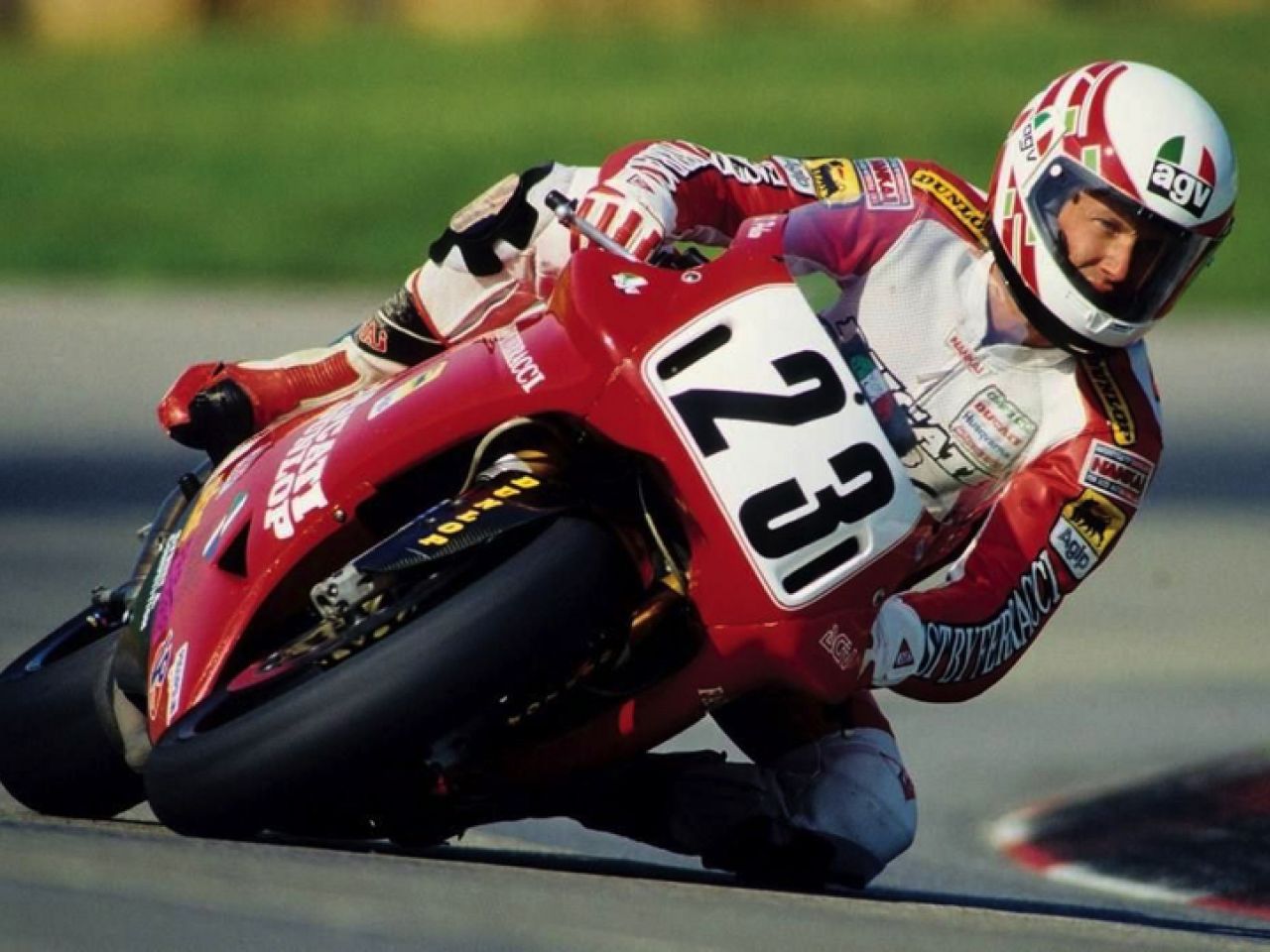
Ducati won the 1992 Superbike Championship with Doug Polen, but a new talent was recruited: Carl Fogarty who came first to the factory Ducati Corse team in 1993. With Massimo Tamburini working on the development of a completely new bike at the factory, Ducati was preparing for a move that would change the company forever.
1994 – The Hammer-Blow to the Industry
In 1994 Ducati was ready to strike the motorcycle world with a hammer blow: the 916. This model proved not only to be a huge success for Ducati, but would also dominate motorcycle styling, even until today.
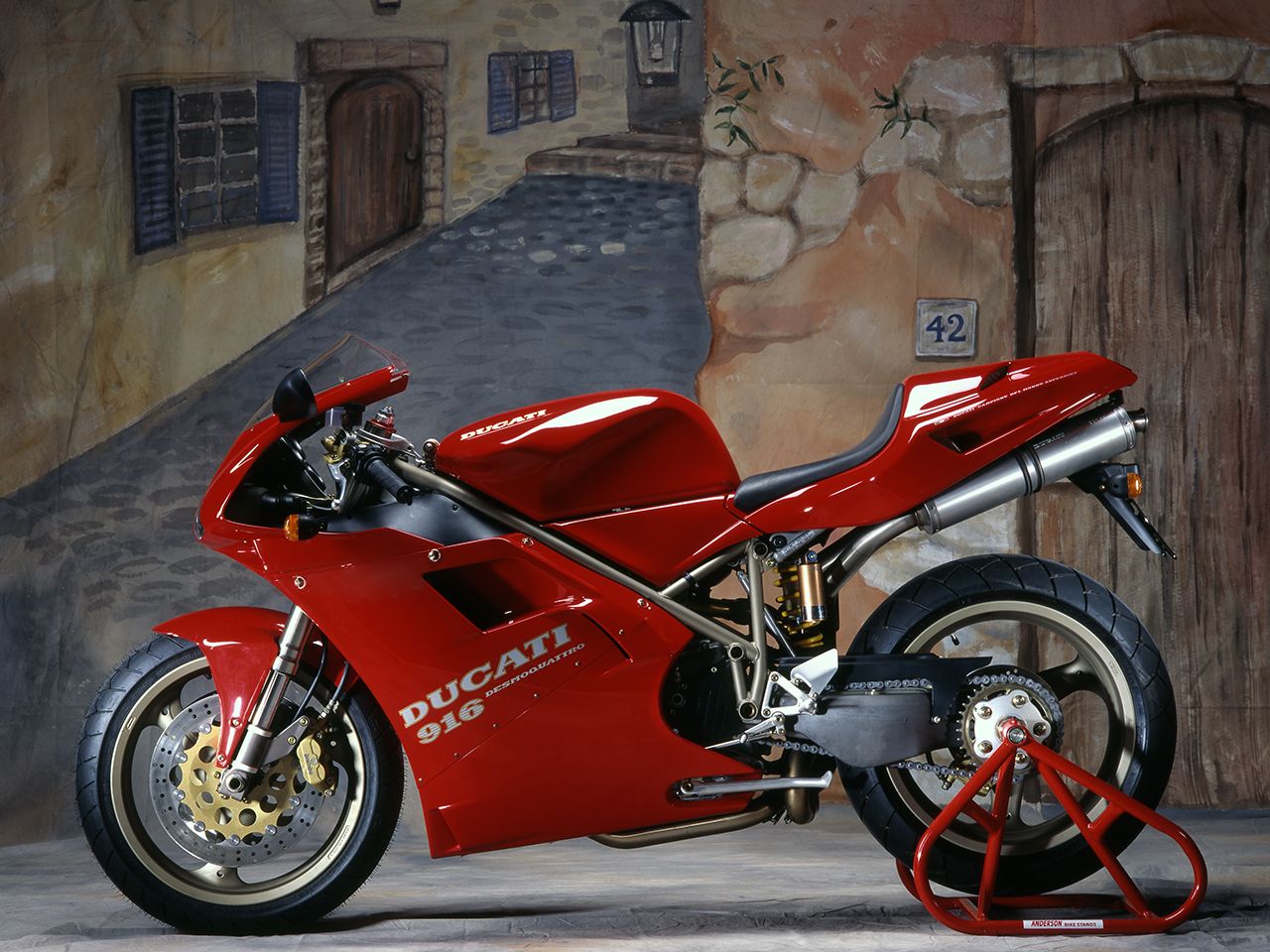
Already in 1987, Massimo Tamburini was recruited by his friend Claudio Castiglioni (then owner of Ducati via his Cagiva company) to develop a completely new superbike around the mighty 888 engine. The approach was completely new for Ducati. Where development of new models used to be evolutionary and based on earlier parts that were constantly upgraded, the development of the 916 began with a clean sheet of paper.
This approach later proved to be very successful; the 916 was revolutionary in many ways, not only for Ducati but for the motorcycle industry as a whole. Where motorcycles used to be a carefully balanced collection of parts, the 916 was the first motorcycle that was designed as a sculpture around a carefully developed chassis that incorporated specification dictated by the race track.
A lot of time and effort was invested in making sure all the advantages and disadvantages of the 888 as learned in the years before, were used for the development of the 916. The wheelbase was shortened, frame rigidity was increased (especially around the steering head) and single sided swingarm was developed for endurance racing.
The genius of Tamburini can however most be seen in the sculptured bodywork of the 916. The shape of the fairing, fuel tank and seat were, for the first time in motorcycle history, all part of the same shape; intentionally creating a woman-like form. Together with the exhaust mufflers swept under the seat and the dual headlights giving the 916 a distinct ‘face’, it is not hard to understand the drooling reactions of all (!) motorcycle enthusiast around the world.
Many people, myself included, were mesmerized by the first sight of the 916 when it was presented to the world at the Milan Motor Show in September 1993. It is one of the few times in history that something so new creates an immediate benchmark for all others to follow.
1994 saw the introduction of the Ducati 916 Strada, only available as monoposto and from 1995 on only with a dual seat (biposto). The 916 was extremely compact compared to other motorcycles of the early 90’s.
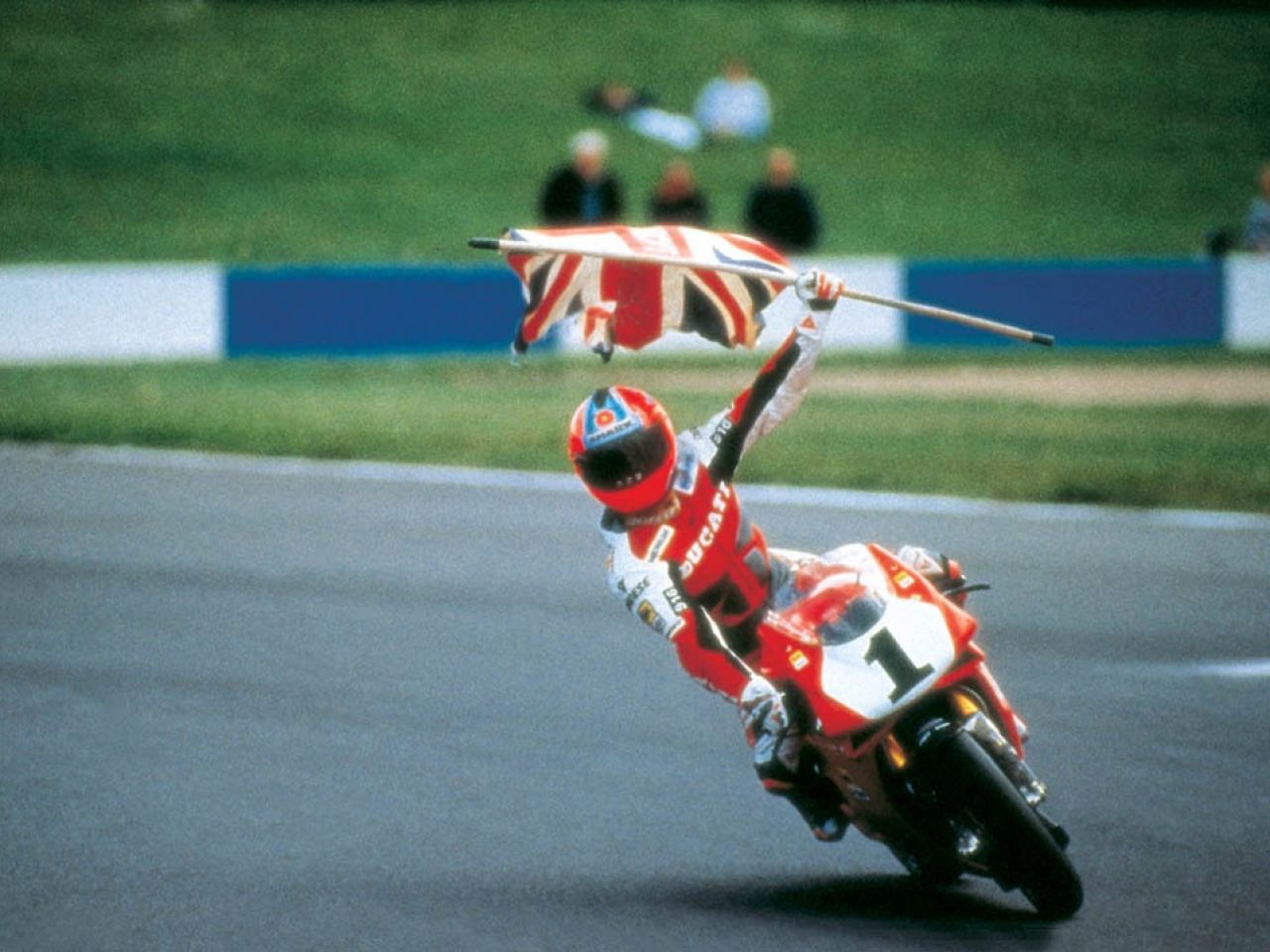
Off course, being first and foremost a racing company, Ducati designed the 916 for the race track. It made its first appearance, driven by Carl Fogerty and Giancarlo Falappa in the World Superbike Championship in 1994, winning its first ever race at Donington and ultimately winning the SBK title in its debut season for Carl Fogerty and the constructors title for Ducati. It also won the World Superbike titles in 1995, 1996, 1998 and 1999. Its predecessor, the Testastretta 998 regained the winning streak in 2001. The 916 Desmoquattro became Ducati’s most successful racing bike.
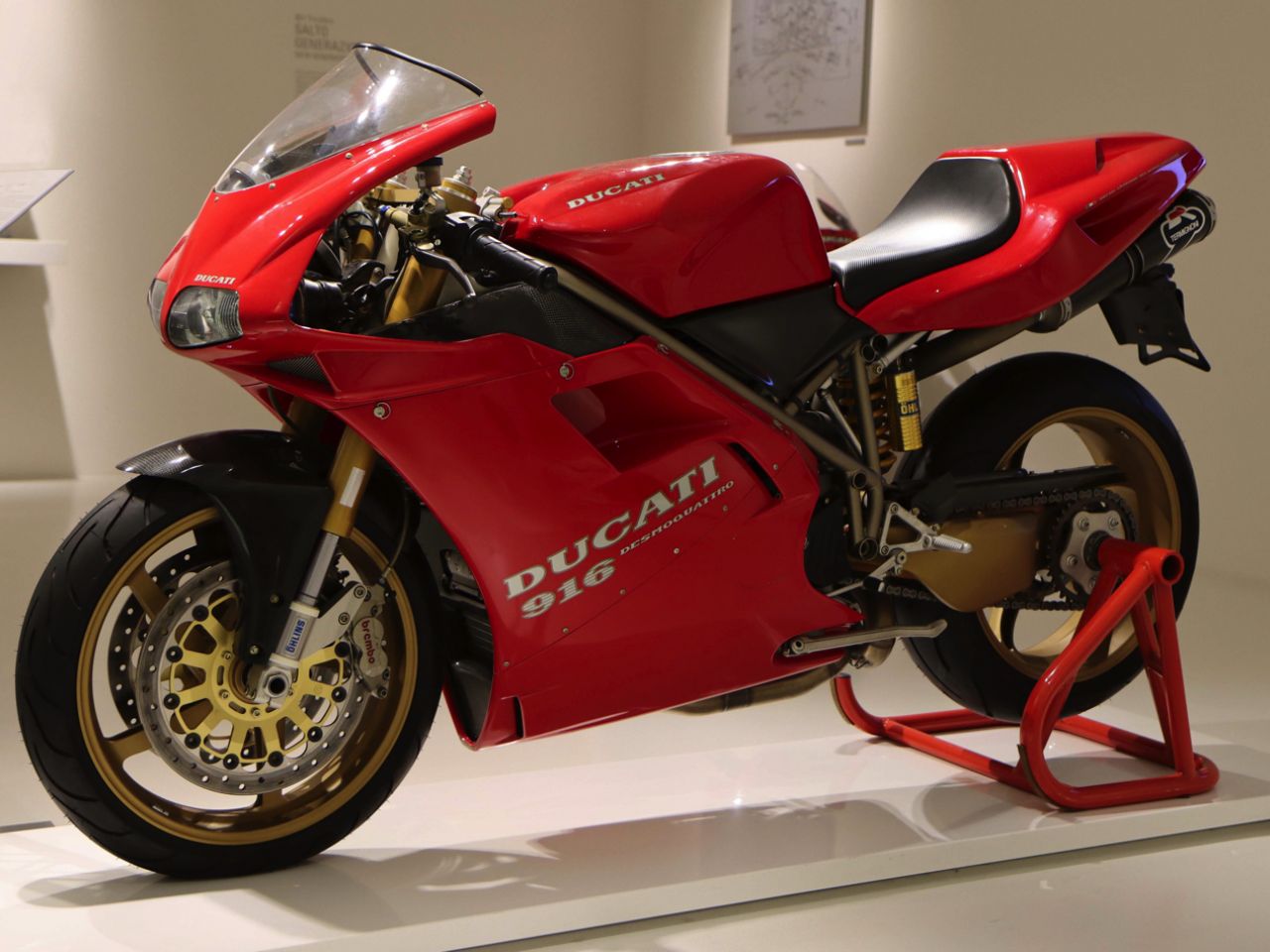
The inspiration for this article came from José Manuel Serrano Esparza who wrote a lovely piece about the development and design of the 916. This particular bike (pictured below) is one of the first three prototypes built by Ducati and remained in the possession of Massimo Tamburini himself until his death in 2014. Commemorating the 25th anniversary of the 916 in 2019, the Ducati Museum in Bologna created an exhibition where this bike was on display. We like to invite you to read the full article by José Manuel Serrano Esparza by following this link.
2020 and beyond – the future for back to classics?
The Ducati Desmoquattro models were extremely important for Ducati and (finaly!) cemented Ducati’s reputation as a manufacturer of the best racing motorcycles on the market. Even the old bevel-drive Ducati’s owe a lot of their popularity to the Ducatis of the 1980’s and 90’s. So what do you think? Should we also develop parts and restoration services for these models? After all, the Desmoquattro bikes have become classics already.